
Church History Tour-- Oct. 3rd - Oct. 13, 2022
We had wanted to go on a Church History tour for a long time. The perfect trip finally came to our attention and we booked it. It was with Living Heritge Tours. Tom Pettit was our tour guide.
We talked Mike and Linda and Ray and Mary Helen into going with us on the trip.
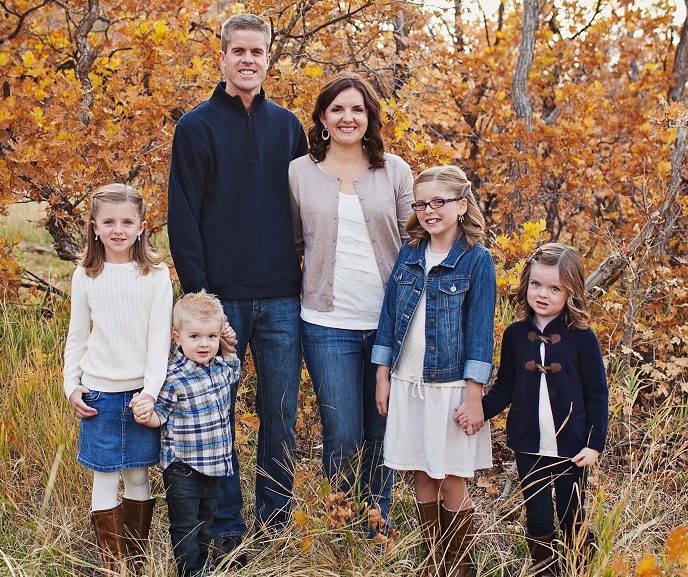
This is a picture of Tom Pettit with his cute family!!!
Monday, October 3rd -Syracuse, NY—We flew to Syracuse New York, arriving there at midnight New York time.


` We took a taxi to our motel and tried to get a little bit of sleep before our tour began the next morning and when we would board the bus and meet the other tour participants. We had already met Tom Pettit.
Tuesday, 4th-– Today was an amazing day. We visited the Hill Cumorah where Joseph Smith was instructed by the angel Moroni on where to find the Gold Plates and then was later instructed to get the plates and translate the Book of Mormon. The translation of the Book of Mormon is a great blessing in our lives. Joseph Smith said the following:
“I told the brethren that the Book of Mormon was the most correct of any book on earth, and the keystone of our religion, and a person would get nearer to God by abiding by its precepts than by any other book.”



We visited the Martin Harris farm --


and the Palmyra cemetery, where Alvin Smith (the prophet, Joseph Smith’s brother) is buried.


And then we were able to spend time walking around the grounds of the
Palmyra Temple. It is beautiful!!


On Wednesday, the 5th, we went to Harmony, PA
and visited the site where the Priesthood was restored,
when John the Baptist appeared and conferred the Aaronic
priesthood on Joseph Smith and Oliver Cowdery.
Just think of all the blessings we have in our lives because
we have the priesthood power and authority available to us!!


And we saw the home where Joseph and Emma lived and the Isaac Hale home.
Most of the Book of Mormon was translated in Harmony.


We saw the Susquehanna River where John the Baptist appeared to Joseph Smith and
Oliver Cowdery and restored the Aaronic priesthood. It was here, in the Susquehanna
River, Joseph and Oliver baptized each other, after being ordained by John the Baptist.


We then went to Fayette, NY and visited the Peter Whitmer Farm. It was here that the
Church was officially organized. It was in Fayette where the Three Witnesses saw the
angel and the plates. Some of the Book of Mormon was also translated at the Whitmer
Farm.


On Thursday, the 6th we went to Niagara Falls. They are beautiful,
spectacular and very WET!!!


On Friday, the 7th, We were in Kirtland, Ohio. We toured the Kirtland Temple.
It was here that the Savior appeared to Joseph and Oliver.
Moses, Elias and Elijah appeared also and restored keys of the Priesthood.
Although it is not owned by the Church, it is a very special place.
It is owned by the Community of Christ Church, formerly the RLDS church.
We ended our tour of the temple by singing “The Spirit of God” and it was a very
emotional moment for us. We sang the song at the suggestion of the man who
was our tour guide at the temple. He belongs to the Community of Christ Church.
He was very knowledgeable of the temple’s origin and history and was very respectful.


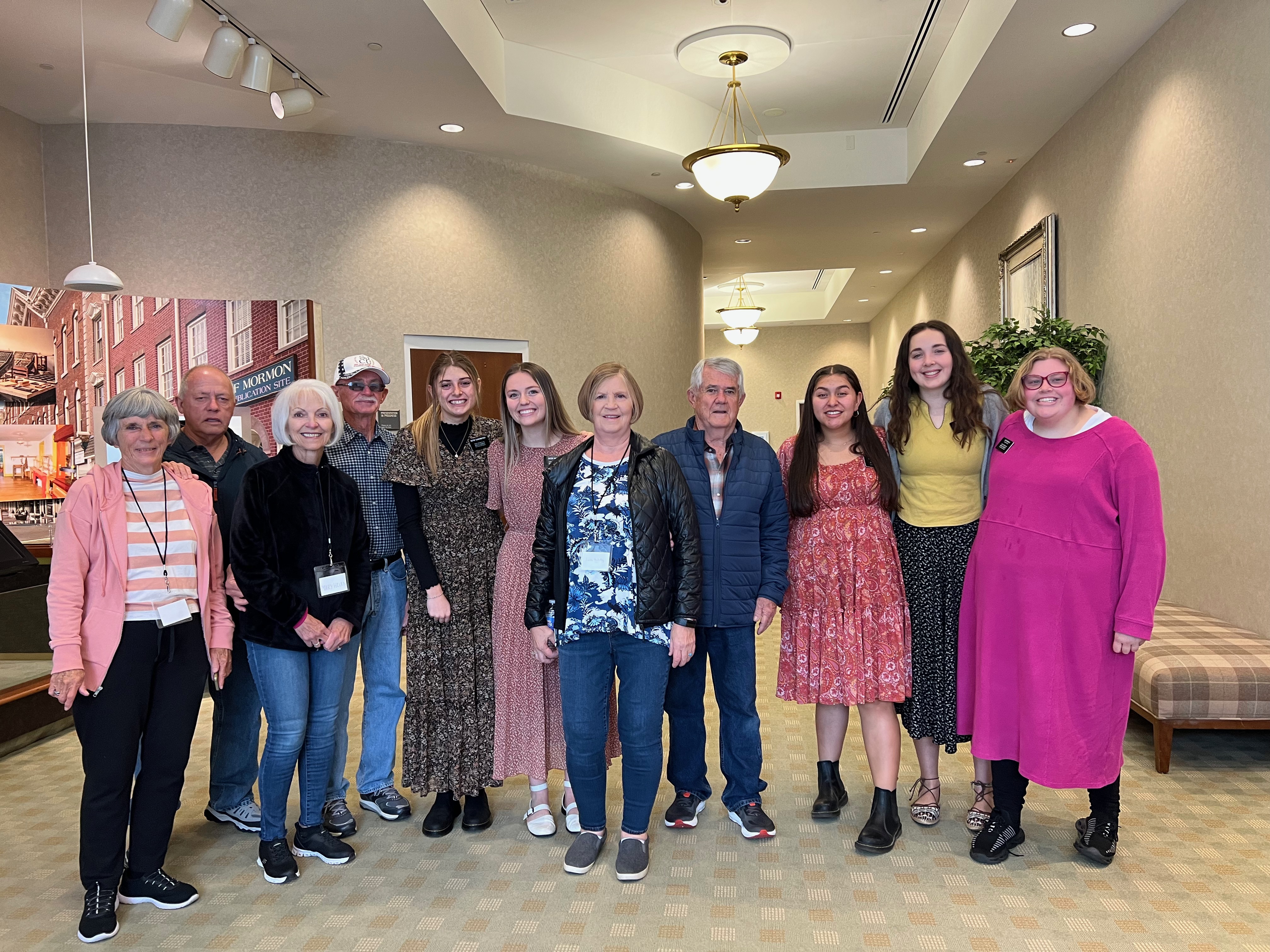
Our tour group by the Kirtland Temple. There was scaffolding around the temple because of
restoration work that was being done!
We visited the Newel K Whitney store, which included the School of the Prophets and
where many revelations, including the Word of Wisdom, were received.


The Ashery


The reconstructed water-powered sawmill


We then went to the Isaac Morley farm, where General Conference
was held, the Father and the Son appeared, where missionaries were
first sent from, and where the first High Priests of this dispensation
were ordained. It has been called “The Little Sacred Grove.
Many amazing events took place here.


We walked through the cemetery and discovered headstones
for many of the early Saints.


We ate dinner at a famous Amish Restaurant. It was a delicious, homecooked meal!!


We visited the John Johnson farm in Hiram, Ohio. The John Johnson Farm was where
section 76 of the Doctrine and Covenants was received.
It was here that Joseph and Sydney saw the Celestial Kingdom, the Father and the Savior.
This is what is contained in section 76. It teaches of the 3 degrees of glory and of the
reward that awaits the faithful: 1–4, The Lord is God; 5–10, The mysteries of the
kingdom will be revealed to all the faithful; 11–17, All will come forth in the resurrection
of the just or the unjust; 18–24, The inhabitants of many worlds are begotten sons and
daughters unto God through the Atonement of Jesus Christ; 25–29, An angel of God fell
and became the devil; 30–49, Sons of perdition suffer eternal damnation; all others gain
some degree of salvation; 50–70, The glory and reward of exalted beings in the celestial
kingdom is described; 71–80, Those who will inherit the terrestrial kingdom are
described; 81–113, The status of those in the telestial, terrestrial, and celestial glories is
explained; 114–19, The faithful may see and understand the mysteries of God’s
kingdom by the power of the Holy Spirit.


And, when we arrived in Kansas City, there were several people in our
group that did not have their luggage at the airport. The luggage was
delayed and caught up with our group the next day.

Sunday, Oct. 9,we were in Missouri. We started the day by attending Sacrament
meeting in Kansas City Missouri. The people on our tour whose luggage had not arrived
yet, did not have their Sunday clothes, only the clothes they had worn the previous day
but that did not stop them from attending Sacrament meeting.
The Kansas City temple is right next to the meeting house. It is beautiful.


We then went to Independence and saw the site that has been chosen for a future
temple. The cornerstones have been placed.


The sign by this building says: “Community of Christ
The Temple”

We then visited Liberty Jail where Joseph and other leaders (Hyrum Smith, Sidney
Rigdon, Lyman Wight, Caleb Baldwin, and Alexander McRae) were held for 5 months
in deplorable conditions Joseph Smith described the experience: “we are kept under a
strong guard, night and day,…our food is scant, uniform, and coarse; we have not the
privilege of cooking for ourselves, we have been compelled to sleep on the floor with
straw and not blankets sufficient to keep us warm; and when we had a fire, we are
obliged to have almost a constant smoke.


Hyrum believed that Joseph had been called of God, and he never wavered in that knowledge or
his faith. Like Joseph, he was persecuted and jailed for his beliefs. After spending months in
Liberty Jail under deplorable conditions, he wrote:
I had been abused and thrust into a dungeon, and confined for months
on account of my faith, and the “testimony of Jesus Christ.” However I
thank God that I felt a determination to die, rather than deny the things
which my eyes had seen, which my hands had handled [the plates from
which the Book of Mormon was translated], and which I had borne
testimony to, wherever my lot had been cast; and I can assure my
beloved brethren that I was enabled to bear as strong a testimony, when
nothing but death presented itself, as ever I did in my life.1

“O God, where art thou?” Joseph asked. The answer came from God: “My son, peace
be unto thy soul; thine adversity and thine afflictions shall be but a small moment; and
then, if thou endure it well, God shall exalt thee on high.

”God is never hidden. #ComeUntoChrist
Link! https://www.churchofjesuschrist.org/.../where-is-the...

We then went to the chosen site for the Far West temple which also has cornerstones
placed. All of these sites have a very special, reverent feeling.


Our last stop of the day was at Adam-ondi-Aman where sacred events have already
occurred and promised millennial events of the future will take place.
It was another spiritual and special day❤


Spring Hill was named Adam-ondi-Ahman by the Prophet Joseph Smith, as indicated by
the Lord in revelation (see Doctrine and Covenants 116). Five weeks later, on June 28,
1838, the third stake of Zion was organized there. An 1835 revelation identified the
valley of Adam-ondi-Ahman as the place where Adam blessed his posterity after leaving
the Garden of Eden (see Doctrine and Covenants 107:53–57).
Adam-ondi-Ahman
As Latter-day Saints gathered to dedicate the Kirtland Temple in 1836, they sang
“Adam-ondi-Ahman,” a hymn composed by William W. Phelps and included in
the newly published Latter-day Saint hymnal. The lyrics celebrated teachings
from Joseph Smith’s revelations about a place called Adam-ondi-Ahman, where
Adam bestowed his last blessing upon his posterity. The hymn also looked
forward to the Savior’s Second Coming, when Adam-ondi-Ahman would be
restored to its former beauty and glory.1
Modern photograph of Adam-ondi-Ahman.

Two years later, while searching for lands the Saints could settle in Daviess
County, Missouri, Joseph Smith and a group of Church leaders found a beautiful
spot near the Grand River with abundant water, wild game, and grass-covered
prairies. Speaking of a prominent knoll in the area called Spring Hill, the Lord in arevelation
explained that He had named it “Adam-ondi-Ahman” because “it is the
place where Adam shall come to visit his people.”2
The Saints rejoiced at this news, and soon families began moving to the area.
They patterned their settlement after the plat of Zion (Joseph Smith’s urban plan
for Independence, Missouri) and identified a location for a temple.3 Leaders
organized the Adam-ondi-Ahman Stake in 1838, one of the first in the Church.4 As
many as two hundred homes were built, but the settlement at Adam-ondi-Ahman
lasted only a few months. Violence soon erupted between the Latter-day Saints
and other Missourians in the fall of 1838, and the Saints at Adam-ondi-Ahman
were forced to abandon their homes.
Monday, 10th-This was a day packed full of historic sights as we visited Nauvoo- we visited Joseph Smith’s home and grave site, the Red Brick Store, the Visitor’s center, Brigham Young’s home, Wilford Woodruff’s home, Heber C
Kimball’s home and other historical sites.


Tuesday, 11th-Nauvoo- this day was also loaded with many historic sites- The
Brickyard, the Browning Home and Gun shop, the John Taylor home, the Lucy Mack
Smith home, the Print shop, the Blacksmith shop and much more.
We got to hang out with some beautiful horses.

And give these beautiful horses hugs and kisses!!

And go for a wagon ride.

We saw these cute “oreo” cows along the way.

It rained on us while we were riding in the wagon.

And then it rained on us when we were walking through Nauvoo!

One of the guys favorite places to visit was the Browning home and Gunsmith shop!


At the Cultural Hall, we saw these young missionaries perform. They were
amazing. They had been called as performing missionaries and specifically assigned to
Nauvoo.


As we wandered around the town, we saw many awesome, historic places.


Wednesday, 12th-We visited Carthage jail in Carthage, Illinois


In the lower room is where the jail cells are located.


The upper room is where, Joseph, his brother Hyrum, John Taylor, Willard
Richards were held. John sang “A Poor Wayfaring Man of Grief”, to help comfort the
prisoners. After John had sung it once, the Prophet Joseph asked him to sing it again.

The mob stormed the jail, shot through the door, striking Hyrum and killing him. The
bullet holes are still visible through the door.
Joseph moved to the window, where he was shot and killed. We felt so many emotions
and feelings as we stood in this spot and realize what had happened there as Joseph
and Hyrum were martyred by the mob.

Joseph paid tribute to his elder brother’s kind heart with these words: “I could pray in my heart that all
my brethren were like unto my beloved brother Hyrum, who possesses the mildness of a lamb and the
integrity of a Job, and in short the meekness and humility of Christ, and I love him with that love that is
stronger than death.”3

A Love Stronger Than Death
This great love between brothers began in their youth. When young Joseph had a severe leg infection that
would later require surgery, Hyrum sat by his bed for hours, putting pressure on the leg to relieve some of
Joseph’s pain.4
Hyrum again stayed by Joseph’s side as they went to Carthage. Joseph had tried several times to keep
Hyrum from danger. A week before they went to Carthage, Joseph wrote, “I advised my brother Hyrum
to take his family on the next steamboat and go to Cincinnati. Hyrum replied, ‘Joseph, I can’t leave
you.’”5 Again, the day before his death, Joseph told those with him, “Could my brother, Hyrum but be
liberated, it would not matter so much about me.”6
Hyrum, however, had made his choice. He would risk safety to stand beside his beloved brother. Joseph
and Hyrum provided each other comfort during their final hours in the jail at Carthage. Hyrum read
from the Book of Mormon and encouraged John Taylor to sing “A Poor Wayfaring Man of Grief,” a folk
song that “had lately been introduced into Nauvoo.”7 Hyrum likely identified strongly with both the
scripture he read and the song he requested, as they reassure the faithful of God’s love in spite of the
world’s rejection.
In his eyewitness account of the martyrdom, a grief-stricken John Taylor penned this tribute to his friend
Hyrum Smith: “He was a great and good man, and my soul was cemented to his. If ever there was an
exemplary, honest, and virtuous man, an embodiment of all that is noble in the human form, Hyrum
Smith was its representative.”


Mike & Linda with our very awesome bus driver, Denny. Denny was the perfect bus
driver. He was so polite and friendly.

We returned to Nauvoo and visited the cemetery, outside of town. It is in this cemetery
where Edward Partridge, first bishop of the Church, is buried. Edward Partridge is Jed’s
great, great, great grandfather. He is also my great, great, great grandfather.


And then we walked down the Trail of Hope, the trail that the Saints walked as they were
forced to leave Nauvoo. It took them to the Mississippi River, which is huge. They had
to cross it as they left their homes, their possessions and the life that they had built in
Nauvoo.


Mississippi River


Departure from Nauvoo
Between February and September 1846, thousands of Latter-day Saints departed Nauvoo, Illinois. The previous fall, Church leaders had developed plans for a large exodus, intending to organize 25 companies of 100 wagons each that would leave in the spring of 1846. Rising hostilities, however, prompted Brigham Young and other leaders to negotiate a truce during fall 1845, which stipulated that Church members would begin their exodus that winter. Between February 4 and March 1, 1846, about 400 wagons ferried around 2,000 Latter-day Saints across the Mississippi River into an encampment at Sugar Creek, Iowa. Another 12,000 Saints crossed into Iowa during the spring and summer, and the remaining hundreds joined the migration in September.1 Church members covenanted to assist the poor among them to make the trek. Church leaders attempted to sell the Nauvoo Temple and other Church properties to help the poor, but they were unable to find a buyer for the temple.
Some past depictions of the departure have suggested that a mob forced the Saints to cross the frozen Mississippi River on the ice. Though the first companies departed earlier than initially planned, the agreement Church leaders made the previous fall prevented mob attacks. Most companies crossed the river peacefully using ferries, though a few may have crossed on the ice between February 25 and March 1.2
As the summer wore on, enemies of the Church in the area grew impatient with the few Latter-day Saints who remained in Nauvoo. Tensions between locals who opposed the Church and citizens of Nauvoo—including many people who weren’t members of the Church but were sympathetic to the plight of the Saints—reached a climax in September 1846. A group of several hundred armed men attacked Latter-day Saints and other defenders of the city. The two sides exchanged several volleys of cannon fire and gunfire, resulting in at least three deaths and a few dozen injuries. A neutral committee stepped in to negotiate the end of fighting, and the remaining Latter-day Saints and their sympathizers were forced to leave the city quickly.3
Most Latter-day Saint evacuees during 1846 made their way to Council Bluffs, in western Iowa, but many remained scattered throughout the surrounding area for months or years. Only a few families stayed in Illinois.
After all of these amazing experiences we were scheduled to fly home on Thursday,
October 13th from the St. Louis, Missouri airport. We were transported to St. Louis by
bus, 3½ hours from Nauvoo. We were so sad to be leaving Nauvoo and the other
places we had visited on our tour and the spiritual experiences we had had there. It
was truly a testimony building, emotion packed 10 days.
We stayed overnight in St. Louis and then we had a lot of hours to explore the city of St.
Louis before our 7:00pm flight to Salt Lake. We went to the Gateway Arch which was
built to honor and remember those who left from the east coast and traveled west. This
included many of our ancestors who had traveled to the Salt Lake valley.
Here is what it says in Wikipedia about the Gateway Arch
From Wikipedia, the free encyclopedia: The Gateway Arch is a 630-foot-tall
(192 m) monument in St. Louis, Missouri, United States. Clad in stainless steel and built
[5] it is the world's tallest arch[4] and Missouri's
in the form of a weighted catenary arch,
tallest accessible building. Some sources consider it the tallest human-made monument
in the Western Hemisphere.
[6] Built as a monument to the westward expansion of the
United States[5] and officially dedicated to "the American people", the Arch, commonly
referred to as "The Gateway to the West", is a National Historic Landmark in Gateway
Arch National Park and has become an internationally recognized symbol of St. Louis,
as well as a popular tourist destination.


We went on a short boat ride to see the Arch from a different view.


After an interesting day in St. Louis we were transported to the airport and caught our
flight for home.
It was such a blessing to see all these Church restoration sites and hear the stories and
learn of the sacrifices made by so many to make it possible for us to have the gospel of
Jesus Christ in our lives. My heart is full of gratitude.
Here is a bunch of additional information about Adam-ondi-Ahman.
The Place Where Adam Shall Come
While the natural abundance of the land in Daviess County provided for the
temporal needs of the gathering Saints, revelation also directed the Saints to a
place of great spiritual significance. As Joseph, Sidney, and George W. Robinson
searched for a location to establish a settlement community near the Grand
River, they came to a prominent knoll called Spring Hill. On this trip, Joseph
received the revelation known today as Doctrine and Covenants 116, which
identified the region as Adam-ondi-Ahman, “because said he it is the place where
Adam shall come to visit his people, or the Ancient of days shall sit, as spoken of
by Daniel the Prophet.”9
The Saints knew of Adam-ondi-Ahman from previous revelations to Joseph
Smith, which were published several years earlier in the 1835 edition of the
Doctrine and Covenants. In what is now Doctrine and Covenants 107, the Lord
explained that during Adam’s final years, he called his righteous posterity to “the
valley of Adam-ondi-Ahman,” where he “bestowed upon them his lasting
blessing.” The revelation further explained that the Lord “appeared unto them”
and “administered comfort unto Adam.” Being “full of the Holy Ghost,” Adam
prophesied concerning his posterity “unto the latest generation.”10 In addition to
references in the Doctrine and Covenants, the phrase had become a regular part
of Latter-day Saint worship services through a hymn composed by William W.
Phelps titled “Adam-ondi-Ahman.”11 This hymn was included in the first Latter-
day Saint hymnal, compiled by Emma Smith and published in the early months of
1836,12 and the Saints sang this hymn during the Kirtland Temple dedication.13
The new revelation concerning Adam-ondi-Ahman suggested a significant role
for Adam in the events preceding the Lord’s Second Coming. Elaborating on
Daniel’s vision of the Ancient of Days (see Daniel 7:9, 13–14), Joseph Smith later
explained that “all that have had the Keys must Stand before him [Adam] in this
grand Council. … The Son of Man [Christ] Stands before him & there is given him
glory & dominion.—Adam delivers up his stewardship to Christ, that which was
delivered to him as holding the Keys of the Universe, but retains his standing as
head of the human family.”14
Gathering to Adam-ondi-Ahman
By revealing the location of Adam-ondi-Ahman to Joseph Smith, the Lord imbued
the land in Daviess County with a spiritual history as well as a spiritual future. At
a time when the development of the kingdom of God upon the earth appeared on
the brink of collapse as a result of apostasy and displacement, this revelationreminded Joseph and the Saints of their place in an unfolding sacred history.
Church leaders were no longer solely working to establish a place for refugee
Kirtland Saints and others desiring to gather, but they were also engaged in the
gathering of the righteous to the location where Adam would one day turn over
his stewardship to the Lord prior to the Second Coming.
Upon Joseph’s return to Far West on May 21, 1838, he immediately held a council
“to consult the bretheren upon the subject of our journey to know whether it is
wisdom to go immediately into the north country … to secure the land on grand
river.” After the brethren expressed their feelings on the subject, “the question
was put by Prest Smith and carried unanymously in favour of having the land
secured on the river and between this place and Far West.”15 Five weeks later, on
June 28, 1838, with Joseph Smith acting as chair, the Adam-ondi-Ahman stake of
Zion was organized with John Smith called as president.16 John Smith’s second
counselor and one of the first Latter-day Saint settlers in Daviess County, Lyman
Wight, wrote: “This beautiful country with its flattering prospects drew in floods
of emigrants. I had not less than thirty comers and goers through the day during
the three summer months.” By October, Wight recorded that “upwards of two
hundred houses” had been built in Adam-ondi-Ahman with “forty families living
in their wagons.”17
“The More Weighty Matters”
Despite the establishment of this new stake of Zion and the call to settle in
northern Missouri, some found it difficult to abandon their homes in Kirtland.
Finally, during the summer months of 1838, most of the loyal Saints remaining in
Kirtland began to make their way to Missouri. Notably absent from the parties of
incoming Saints were William Marks and Newel K. Whitney, a Kirtland bishop
and wealthy businessman. The pair initially neglected to gather with the main
body of the Church in Missouri in order to settle their business affairs in Kirtland.
The two struggled with abandoning the temporal security their businesses and
property provided.
On July 8, 1838, Joseph Smith received a revelation (now Doctrine and Covenants
117) directed to Marks and Whitney commanding them to “come forth, and not
tarry.” The revelation called Marks to “preside in the midst of my people in the
City Far West,” presumably as the new president of the Missouri stake
presidency. As for Whitney, the revelation directed him to “come up unto the
land of Adam-ondi-Ahman, and be a bishop unto my people.”18 Using the imagery
of Adam’s ancient homeland and the infinite blessings promised to Adam’s
posterity, the revelation queried: “Is there not room enough upon the mountains
of Adam-ondi-Ahman, and upon the plains of Olaha Shinehah, or in the landwhere Adam dwelt, that you should … covet that which is but the drop, and
neglect the more weighty matters?”19 Oliver Granger was designated to settle all
the Church’s accounts in Kirtland, and he delivered a letter to Marks and Whitney
containing the revelation. In the letter, the First Presidency expressed confidence
in the pair’s willingness to obey the revelation and to “act
accordingly.”20 Obedient to the instruction, both Marks and Whitney forsook their
possessions in Kirtland. Eventually they joined with the main body of the Saints
to attend to the “more weighty matters” of administering to the needs of the
Saints.
Epilogue
Throughout the summer of 1838, the Saints continued to gather to Far West,
Adam-ondi-Ahman, and other Latter-day Saint settlements in northern Missouri.
In accordance with the command to build up Far West, on July 4, 1838,
cornerstones were laid for a temple in that community. Soon a site had also been
selected for a temple in Adam-ondi-Ahman. However, the peace and abundance
the Saints enjoyed in northern Missouri was short-lived. Simmering mistrust and
suspicion between Missourians and Latter-day Saints erupted violently in August
1838. A series of armed conflicts known as the Missouri-Mormon War
culminated with the imprisonment of Joseph Smith and the expulsion of the
Latter-day Saints from Missouri. After the expulsion of the Saints from their state,
Missourians immediately swooped in to lay claim to the Mormon lands and
improvements. Although they would go on to establish another covenant
community and build a beautiful temple in Nauvoo, the Saints maintained a hope
that they would one day return to reclaim these sacred lands in Missouri prior to
the Second Coming.


